What Are Growth Factors?
When your skin gets a cut, it heals on its own. When you were young, it healed fast and left little to no scarring. The biological force behind that healing ability is called a growth factor.
Growth factors are naturally occurring proteins in the human body that act as cellular messengers. They carry signals between skin cells — instructions like "start regenerating here," "produce more collagen," or "divide and replace damaged cells." Think of them as the body's internal management system for skin health and repair.
"If ordinary skincare fills in the results from the outside, growth factors instruct your skin to create those results itself — from within."
The significance of growth factors was first recognized in 1962, when American biologist Dr. Stanley Cohen discovered EGF (Epidermal Growth Factor). The discovery was so groundbreaking that it earned him the 1986 Nobel Prize in Physiology or Medicine. What began as wound-healing research has since evolved into one of the most exciting frontiers in aesthetic dermatology.

Healthy, luminous skin — the visible result of active cellular regeneration at work.
The Signal That Fades with Age
In your 20s, growth factors are abundant. Skin regenerates quickly, collagen is produced efficiently, and elasticity is maintained with little effort. But starting in your 30s, the body's natural production of growth factors begins a slow, steady decline.
What happens when the signals weaken? Collagen production slows. The cell renewal cycle lengthens. The skin barrier becomes less resilient. Wrinkles, sagging, enlarged pores, dull tone — virtually every visible sign of aging can be traced, at least in part, back to a reduction in these critical biological signals.
production starts declining
by your 40s
for skin booster treatments
This is exactly where growth factor-based skin boosters enter the picture. Rather than simply adding moisture or temporary filler from the outside, they work to restore the cellular signals that prompt your own skin to regenerate collagen, renew cells, and rebuild its structure. It is the difference between treating symptoms and addressing the source.
Key Growth Factors That Affect Your Skin
Growth factors are not a single substance — they are a family of specialized proteins, each with a distinct role. The skin relies on multiple types working in concert. Here are the most important ones.
Epidermal Growth Factor
The most well-known growth factor. Stimulates skin cell regeneration and promotes the production of collagen and elastin. The 1986 Nobel Prize-winning discovery.
Fibroblast Growth Factor
Activates fibroblasts — the cells directly responsible for producing collagen and elastin. Essential for maintaining tissue regeneration and skin firmness.
Insulin-like Growth Factor
Regulates overall cell proliferation, differentiation, and development. Plays a central role in repairing damaged skin and supporting comprehensive regeneration.
Transforming Growth Factor-beta
Oversees collagen remodeling in the dermis. Critical for improving skin firmness and reducing the appearance of fine lines and wrinkles.
Platelet-Derived Growth Factor
Promotes cell growth, differentiation, and migration. Particularly effective in wound healing and tissue regeneration processes.
Keratinocyte Growth Factor
Specifically targets keratinocytes on the skin's surface. Contributes to strengthening the skin barrier and maintaining moisture retention capacity.
The key insight here is that these growth factors work far more powerfully in combination than in isolation. Using only one growth factor is like having an orchestra perform with a single instrument. When multiple growth factors operate together — each carrying out its designated role — the resulting skin regeneration is comprehensive, layered, and lasting.

Growth factor research bridges biotechnology and aesthetic medicine — laboratory science translated into real skin results.
Why Growth Factors Belong in Skin Boosters
Conventional skincare and growth factor-based skin boosters operate on fundamentally different philosophies. Understanding the distinction helps explain why dermatologists and aesthetic clinicians have increasingly turned to growth factor protocols.
| Category | Conventional Skincare | GF-Based Skin Booster |
|---|---|---|
| How it works | Delivers ingredients to the skin surface | Sends regeneration signals to skin cells |
| Core approach | Fills in results from the outside | Skin produces its own results |
| Durability | Effects fade when use stops | Cellular function itself improves |
| Depth of action | Epidermis (surface layer) | Dermis (cellular level) |
| Primary targets | Immediate hydration and protection | Collagen production, cell renewal |
Growth factor skin boosters also excel when combined with other aesthetic procedures. They are widely used in clinical settings following laser treatments, microneedling, and mesotherapy — accelerating recovery, reducing post-treatment inflammation, and extending the life of results. Whether used as a standalone protocol or as a finishing step in a complex treatment, their compatibility with other modalities makes them a cornerstone of modern aesthetic practice.
BioPlus Innovation — 18 Growth Factors, Two Breakthrough Technologies
If growth factors are so effective, why don't all products deliver the same results? The answer lies in two fundamental technical challenges that most products fail to fully solve: skin penetration and ingredient longevity.
Challenge 1 — Growth factors struggle to penetrate skin
Growth factors are large-molecule proteins. The skin's stratum corneum is specifically designed to block external substances from entering. Most growth factor products never make it past this barrier — the active ingredients sit on the surface, unable to reach the dermal cells where they need to work.
Challenge 2 — Even if they reach the dermis, they are rapidly broken down
Even when growth factors do penetrate to the dermis, the body's natural immune response tags foreign proteins with "ubiquitin" markers, flagging them for destruction. Standard growth factors are broken down within hours of entering the cell, dramatically limiting their clinical effect.
Two patented technologies.
Both problems solved.
After more than 20 years of research, South Korean biotech company BioPlus developed two patented technologies that directly address both challenges. The result is not just a better formulation — it is a fundamentally different category of product.
Modifies the protein structure of growth factors to block the binding site of Ubiquitin E3 ligase — the enzyme that tags proteins for destruction. Clinical studies show 660% longer cellular retention compared to standard formulations.
A biocompatible transdermal delivery system engineered to carry active ingredients through the stratum corneum and into the dermal layer. Clinically verified to achieve 205% better cellular absorption versus non-BMTS formulations.
A proprietary blend of 18 growth factors — including EGF, bFGF, TGF-β, and IGF-1 — formulated to address skin regeneration from multiple biological pathways simultaneously. Far broader in scope than single-factor products.
Growth factors are synthesized to match the exact structure of those naturally produced by the human body, minimizing immune reaction and allowing the skin to receive and act on the signals naturally.
Cellular-level regeneration, made real
BioPlus's flagship skin booster, Shine Plus Aura, combines the AUT® and BMTS® technologies with its full 18-growth factor complex. Clinically designed to improve pore appearance, skin texture, wrinkle depth, and oil-moisture balance — with a recommended protocol of one treatment every three weeks, at least three sessions over three months.
Available in a professional medical line for in-clinic use and a homecare line for daily maintenance, Shine Plus Aura is designed as a complete system — not just a one-time treatment.
What to look for in a growth factor product
The market is full of products that mention growth factors. Here are the four questions that separate genuine science from marketing language.
How many growth factors, and which ones?
Single-factor products (EGF alone) offer a narrow benefit. Look for a complex of multiple growth factors that address the full spectrum of skin regeneration pathways.
Is there a verified delivery system?
If growth factors can't penetrate past the skin surface, they cannot work. Look for a documented transdermal delivery technology — not just a claim of "deep penetration."
How long do the ingredients stay active?
Ingredient stability inside the cell determines real-world efficacy. Look for anti-degradation technologies that extend the active lifespan of growth factors after delivery.
Is the technology patented and clinically validated?
Registered patents and published clinical data are the gold standard. Specific numbers — absorption rates, retention times, improvement percentages — are the evidence that matters.
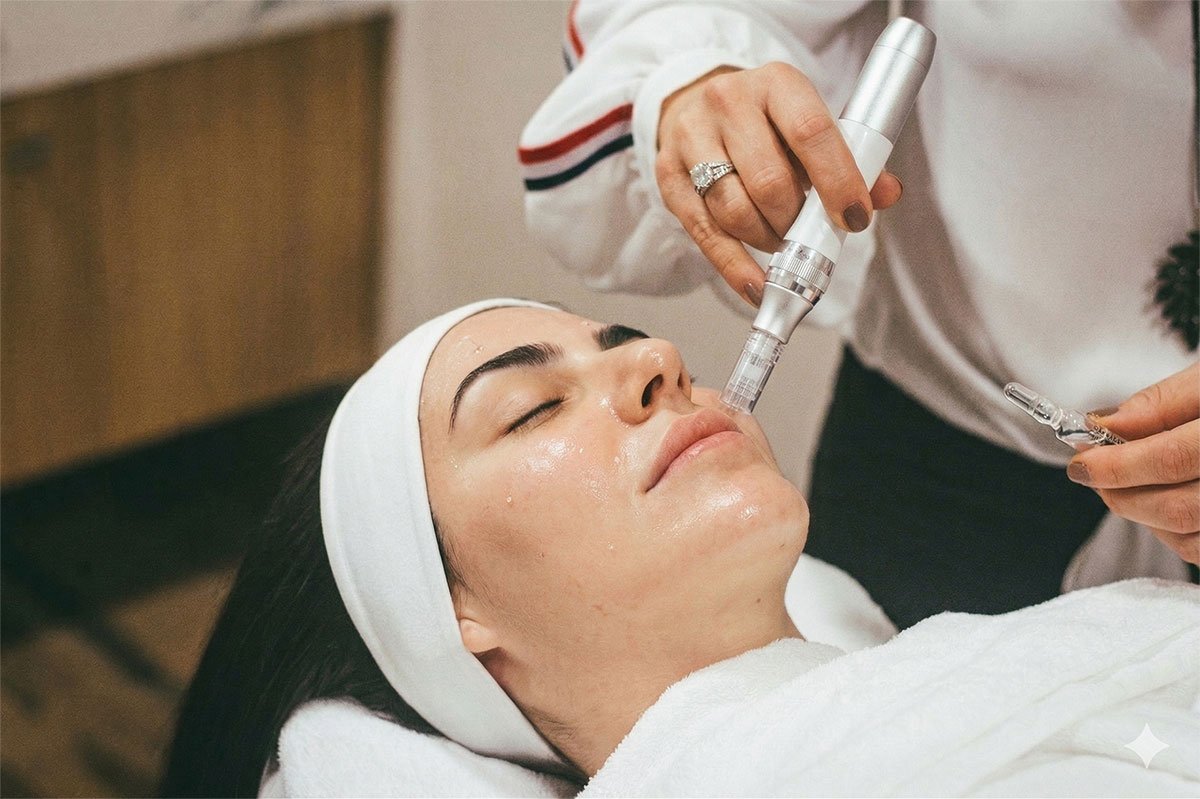
Growth factor skin boosters are administered by trained professionals in clinical settings, often alongside microneedling and mesotherapy protocols for enhanced results.
Frequently Asked Questions
Who is a good candidate for growth factor skin booster treatments?
Anyone experiencing the early to mid signs of skin aging — typically from the 30s onward — can benefit. Ideal candidates are those looking to improve wrinkles, enlarged pores, loss of elasticity, acne scarring, or uneven skin tone. Growth factor treatments are effective regardless of gender or skin type.
Can growth factor boosters be used alongside regular skincare?
Yes. Growth factor skin boosters are designed to enhance, not replace, your existing skincare routine. Using a compatible homecare line after in-clinic treatments helps maintain and extend the results between sessions.
How long do the results last?
Results vary by individual, but completing a full three-session course (once every three weeks over three months) typically produces effects that last several months. Maintenance treatments approximately twice a year are recommended thereafter. BioPlus's AUT® technology extends the cellular retention of growth factors by 660%, meaning results outlast those of standard formulations.
Are growth factor treatments safe? Are there side effects?
BioPlus growth factors are synthesized to match the body's own proteins, minimizing the risk of adverse reactions. Treatments should be administered by a qualified professional in a clinical setting. Mild redness or swelling immediately after injection is a normal response and typically resolves within 24 to 48 hours.
Are growth factor skin boosters only for women?
Not at all. Growth factors are biological signals that operate identically in all skin, regardless of gender. For men who don't follow an extensive skincare routine, a professionally administered skin booster can actually be a more efficient and effective approach to skin health than a multi-step daily regimen.
Experience the science
of skin regeneration
Interested in learning more about BioPlus growth factor skin boosters? Visit the official site or consult a clinic near you.
Visit BioPlus USA Official Site